
Trace Elmore County Former Owners Through Time
Begin with the most recent instrument on file with the Elmore County Recorder. Use each seller's name as the next historical key. The county publishes no public current deed index online. A direct request to the office is the dependable route. With that request, provide the parcel ID, legal description, likely party names, recording date, and any deed reference from the parcel popup. The older online sources cover useful but uneven spans.
| Trail source | Documented span | Access point | Ownership clue |
|---|---|---|---|
| Current recorded instruments | Confirm with office | County Recorder, counter or focused request | Grantor, grantee, date, instrument, and legal description |
| Digitized deeds | 1884 to 1960 | FamilySearch Elmore collection | Images and deed text, subject to collection access limits |
| Grantee deed index | 1906 to 1950 | FamilySearch | Buyer-side index entries |
| Grantor deed index | 1907 to 1998 | FamilySearch | Seller-side entries that extend later than deed images |
Collection labels never promise full indexing. Record the image number, book and page. Add the names and legal description for every match. Ask the Recorder for deed-book or index references. Do this when the chain outgrows the online span. Archival catalogs can add context for those years. The official Recorder page confirms the office route for deeds, mortgages, plats, and releases.
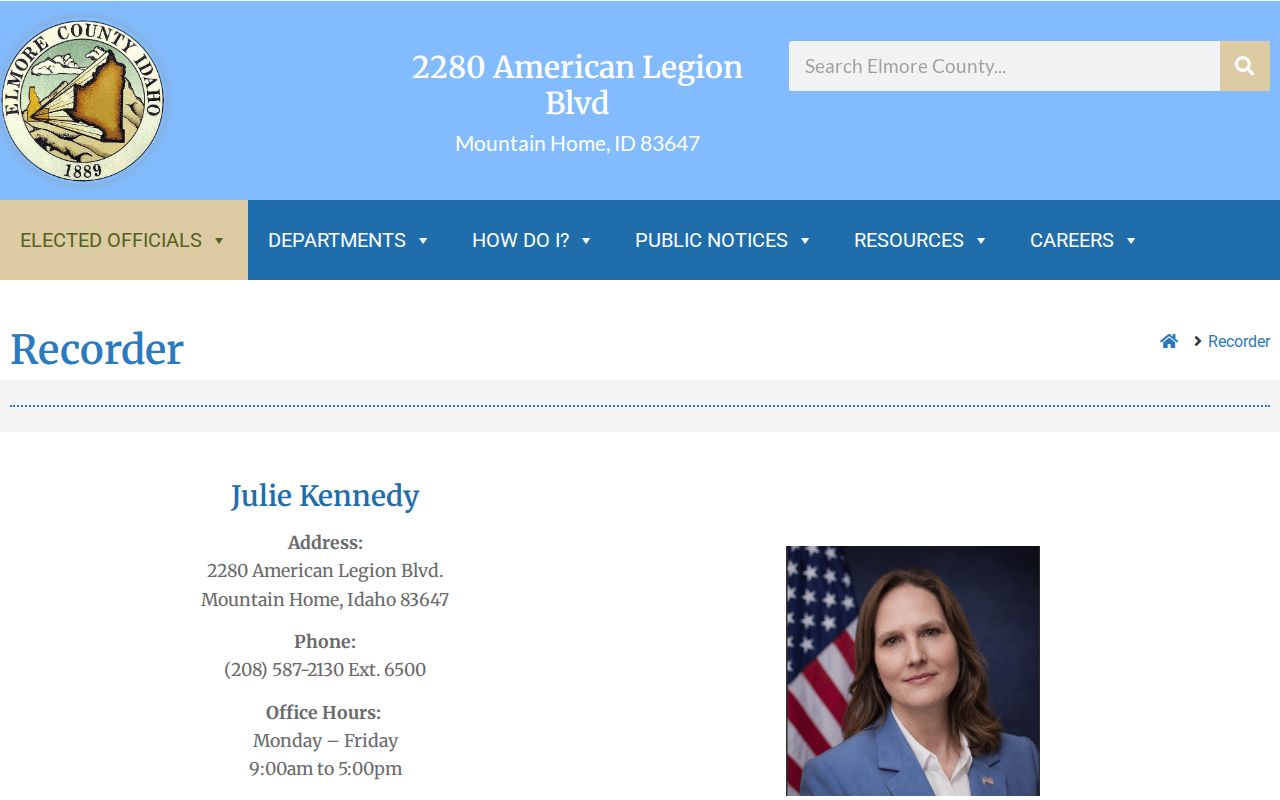
That page offers no searchable current ownership chain. Its value lies in supporting the handoff to the recorder's office rather than in any claim of online coverage.
Elmore County's Uneven Online Ownership Window
The Idaho, Elmore County Records, 1889-1972 collection draws on county clerk records kept in Mountain Home. It holds 26,811 images and 16,173 records. These labels show why a single name search can miss former owners. Deed images end in 1960. The grantee index stops at 1950, but the grantor index runs on to 1998.
Use the longest index as a locator. It is no substitute for the deed itself. FamilySearch restricts some images to signed-in users or affiliate centers. A careful citation log records the collection title and index side. It should also note the image or film reference, book and page, and access date. The originals are courthouse records. So Elmore County remains the confirmation point for any deed in question.
Note: Uneven index spans can suggest a gap even when the underlying Elmore County deed exists.
A Backward Transfer Ledger for Elmore County Property
Build a working ledger before trusting conclusions about former owners. Each row should describe a recorded event, not a biography or an assumption about possession. The arrow runs from the person or entity conveying an interest to the recipient named in that instrument.
| Transfer date | Grantor to grantee | Instrument type | Book, page, or number |
|---|---|---|---|
| Newest verified date | Seller to current grantee | As recorded | Copy exactly |
| Earlier acquisition | Prior grantor to that seller | As recorded | Copy exactly |
| Earlier link | Repeat from the new grantor | As recorded | Preserve deed-book citation |
Keep the legal description beside the ledger. Similar names prove nothing on their own. Two records concern the same parcel only when a stable lot, block, subdivision, or township-range-section description connects them despite address changes.
Reconstruct the Elmore County Deed Chain in Reverse
A current parcel record holds real clues. It lists the APN, situs, an owner-name lead, legal lines, and sometimes deed-reference fields. Treat them as pointers, since they are assessor and GIS attributes rather than a complete Recorder index. Find the newest deed, then reverse each transfer.
- Find the newest deed for the same parcel or legal description and verify its grantee.
- Read the grantor named on that deed. That party is the next prior-owner lead.
- Search the grantor as a grantee in an older index, testing initials, spelling, married names, and entity suffixes.
- Repeat, recording every date and reference; shift to deed books, archives, or a focused office request when online coverage ends.
- Grantor and grantee
- The conveying party and receiving party named on an instrument.
- Chain of title
- The linked sequence of recorded transfers affecting the same land.
- Reverse index
- An index organized from one side of a transfer, used with its companion index to move through names.
- Warranty and quitclaim deeds
- Different forms of conveyance whose legal effect must be read from the actual instrument.
Mountain Home Townsite Clues for Previous Owners
Downtown Mountain Home searches run into vocabulary older than modern APNs. The original townsite plat dates to 1883. It was recorded in 1887, after the settlement moved from Rattlesnake Station toward the railroad. Earlier instruments may use original townsite, lot and block, railroad, depot, or period street terms. Pair that vocabulary with the parcel's legal description. Today's geometry can orient the search. It cannot prove that plat lines match. A recorded plat, replat, boundary instrument, and linked deed chain form the stronger bridge.
Elmore County Estate Files Can Bridge a Missing Owner
A tidy deed chain can stop at an estate. Look for personal representative language in the deed record. Then check probate-related files for a will, letters, an order, or a distribution. These should be tied to the same land and names. The statewide Idaho iCourt portal can supply case clues. But sealed records, search syntax, retention, and the transition between Portal and Repository can all affect results.
Vital records follow separate rules. Use them only for a genuine estate or property-right issue. A parcel search is not a person profile. The recorded representative deed or distribution instrument remains the essential property link.
Note: A court no-result does not prove an Elmore County estate or transfer never existed.
Search Elmore County Names Without Losing the Parcel
Old indexes rarely spell a name the way you expect. Entries get shortened, and punctuation disappears. A business or trust may also stand in for the individual behind it. Search each variant on its own. Try the surname, initials, a married-name form, and the entity name. FamilySearch adds keyword, location, record type, batch, film, and exact-match controls. When a name alone returns too much, add another filter. Fold in a township, range, section, subdivision, or street term.
Every candidate must resolve to the same legal description. A shared surname in Elmore County proves nothing about the land in question. Compare the instrument image and the parcel description. Check spouse or status wording, deed type, and any later reference to the same transaction. For an entity, the Idaho SOS business search can settle the exact filed name. It still cannot replace the deed itself.
Stay anchored to the recorded transfer. Keep the focus on land and title history. Do not turn a former-owner chain into a profile of a living person. Skip mailing data that adds nothing to the story of ownership.
Ask for Older Elmore County Books and Images
The Recorder's counter sits at 2280 American Legion Boulevard in Mountain Home. It is reachable at 208-587-2130 extension 6500, weekdays from 9 a.m. to 5 p.m. The office publishes no online index, copy schedule, certification path, or historical volume list. A narrow request beats a broad one every time. Ask for specific books and instruments rather than "all former owners."
Include the APN, the situs address, the full legal description, the parties, a date range, and the last known book/page or instrument number. Then ask which grantor and grantee books cover the period. Ask whether images or microfilm exist, and what copy and certification charges apply. Ask how results can be delivered. Idaho's public-records guidance offers a fallback route. It works when there is no portal and a written request becomes necessary.
How Far Back Elmore County Former-Owner Records Reach
Elmore County dates to 1889. The deed collection, though, labels some material from 1884 and patents running through 1997. Any chain reaching before county formation may need territorial or predecessor-county work. The Idaho State Archives catalogs can surface a name, plat, road action, or legal notice. So can finding aids, local histories, gazetteers, and newspapers. Treat them as context. They are not proof of present title.
Glenns Ferry brings its own vocabulary. Gustavus Glenn's ferry, Stockton railroad land, the 1888 townsite, the depot, and railroad facilities all mark different eras of the record. Fires in 1893 and 1897 damaged buildings in the original townsite. The city history does not claim that county deeds or plats were lost. Keep evidence about buildings separate from the question of which land records survive.
Record limit. Online Elmore County coverage is uneven and ends at different years. Older ownership requires deed books, index references, archival clues, and Recorder confirmation.