
Types of Elmore Deed Records
The Elmore County Recorder keeps the current deed books. The office accepts warranty and quitclaim deeds, trustee and tax deeds, deeds of trust, mortgages, assignments, reconveyances, releases, easements, covenants, liens, plats, surveys, boundary instruments, lease memoranda, and affidavits. Each instrument does its own job. Before concluding what a filing did, read the caption, the parties, the legal description, the recording date, and the instrument reference.
| Deed Type | What It Does | Common Use |
|---|---|---|
| Warranty deed | Conveys the stated estate with deed warranties | Ordinary sale transfer |
| Quitclaim deed | Conveys whatever interest the signer has | Interest cleanup or related-party transfer |
| Trustee deed | Conveys in a stated trustee capacity | Trust or foreclosure-related transfer |
| Personal representative deed | Conveys through estate authority | Probate sale or distribution |
| Tax deed | Records a transfer after the tax-deed process | Delinquent-tax proceeding |
A mortgage or deed of trust is not a deed. Neither is a lien. These instruments burden land without conveying the ownership estate itself. Trace each one to any assignment, reconveyance, satisfaction, or release. Those filings are what clear it from the record. A plat works differently too. It defines lots and features rather than transferring title.
Reach the Elmore Recorder
Elmore County publishes no online grantor-grantee index, image viewer, or copy checkout. The direct route is the Recorder at 2280 American Legion Boulevard, Mountain Home, Idaho 83647, 208-587-2130 extension 6500. Posted hours are Monday through Friday, 9 a.m. to 5 p.m. Call ahead. Confirm the current search method, index years, image access, copy and certification fees, delivery options, and payment methods.
Bring specifics to the counter. A parcel ID, situs address, full legal description, party names, date range, and any known book, page, or instrument number will find the right Elmore County deed records far faster than a broad name request. Statewide Idaho recording fee references do not set the Recorder's current copy price, so ask before ordering.
The official Recorder page lists the county contact route for current Elmore County deed records.
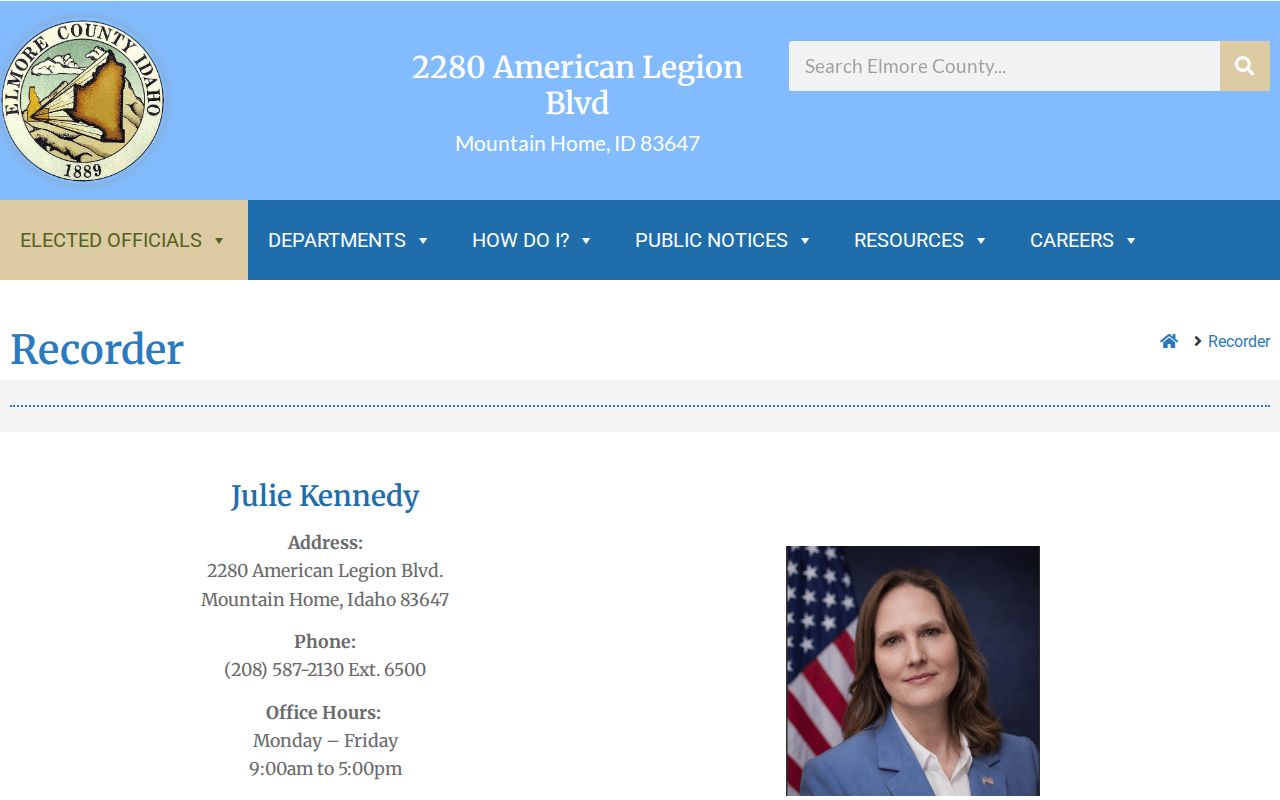
The Recorder page shows the office contact channels plainly. With no public index posted, counter, phone, and written requests remain the working access routes.
Note: An office route exists, but no public current deed-search form does, making direct requests the essential channel.
Elmore Deed Search Fields
The current office search fields are not published online. The historic FamilySearch collection does expose search inputs that help with older deeds. Treat those as archival leads, not as substitutes for the Recorder's current index.
| Historic search field | Useful input | How to verify |
|---|---|---|
| Name | Grantor, grantee, or related party | Match deed image and legal description |
| Event and year | Known transfer period | Preserve the displayed date and reference |
| Place | Elmore County or townsite | Check county formation and place history |
| Keyword | Street, subdivision, lot, or legal phrase | Compare to plat and Recorder record |
| Batch or DGS | Known collection reference | Record image and page provenance |
Some images sit behind an account or an affiliate site. An index entry or transcription is only a pointer until you read the underlying instrument itself.
Historic Elmore Deed Coverage
FamilySearch's “Idaho, Elmore County Records, 1889–1972” collection lists deed images from 1884 through 1960, a grantee index from 1906 through 1950, and a grantor index from 1907 through 1998. Those spans do not match. A name in the later grantor index may lead to an image missing from the same online set. That gap matters. Record the exact index citation, then ask the Recorder or Idaho State Archives where the named book or image can be inspected.
Never assume the whole chain is online. Older material may live in deed books, microfilm, courthouse holdings, or predecessor and territorial sources instead. This mismatch is one of the most useful facts in Elmore County deed research.
Elmore Instruments in Practice
Two county samples show why instrument references matter. A 1988 warranty deed carries instrument number 248589 and spells out a long township, range, and section description. A memorandum of lease recorded January 17, 2023 carries instrument number 503547 and documents an LLC and a land-lease clue. Neither is a template for every parcel. Deed records hold more than a buyer and a seller. Capacity, entity name, description, dates, and later references can change the reading. Ask for linked assignments, releases, plats, or later instruments whenever the text points to them. To resolve an entity's name and status, search official Idaho business resources, then return to the recorded land document.
Townsites Complicate Elmore Deeds
Mountain Home's original townsite plat was prepared in 1883. It was recorded in 1887. That came before Elmore County itself formed in 1889. Records around that townsite may lean on lot and block language. They may also use railroad terms, “Rattlesnake Station,” or older place names instead of a modern APN. If the county chain begins abruptly, check predecessor and territorial records. Glenns Ferry's original townsite was platted in 1888 after ferry and railroad development. Helpful archive terms include Stockton, depot, roundhouse, King Hill, and the 1893 and 1897 fires. Those fires damaged town structures, but county deed books are not shown destroyed. Check newspaper or city-history clues against a plat and a Recorder filing.
Plats Beside Elmore Deeds
Elmore County's final-plat application asks for a legal description, survey corners, lots, blocks, roads, easements, and adjoining subdivisions. Covenants and signatures are required too. Note: the $800 application fee plus $30 per lot covers planning review, not deed copies.
Plat stages deserve care. Proposed, approved, recorded, and conveyed mean different things. A preliminary packet such as Greenwood Estates or PP-2025-08 can name an APN, proposed divisions, access, and utility facts. That is not proof. It does not show that a final plat or later deed was recorded. Get the final plat's recording reference and each later conveyance before saying the land changed hands.
Trace Elmore Grantors and Grantees
A chain of title is the ordered sequence of recorded transfers affecting one piece of land. Start from the newest reliable deed. Skip the assessment owner alone. The grantee receives the parcel. The grantor conveys it. Then search that grantor as an earlier grantee, matching the legal description and instrument references at every step.
- Use the parcel map for an APN, current roll name, and legal-description clue.
- Request the latest vesting deed and verify that its land description matches.
- Read the grantor, then search that party as a grantee in the prior period.
- Log each date and reference, including releases, easements, and corrective deeds.
- Move to deed books, microfilm, or archives where online historic coverage ends.
- Grantor
- The party stated as transferring an interest.
- Grantee
- The party stated as receiving an interest.
- Chain of title
- The sequence of land transfers and related filings.
- Book/page
- A volume and page citation for a recorded item.
- Instrument number
- A unique recording reference assigned to a document.
Request an Elmore Deed Copy
Ask the Elmore County Recorder whether a plain or certified copy fits the purpose. A plain image aids research. Certification attests the copy came from the custodian. Give the instrument number if known. Otherwise supply party names, recording period, APN, legal description, format, and delivery preference. Confirm search and copy charges before sending payment.
Court pleadings need a different route. The Elmore District Court's specialized records form handles documents and certified documents by pickup, email, or mail, with its own stated court fees and sealed-record rules. That access never replaces the Recorder's copy of the land instrument.
Recorded, not guaranteed. Elmore County deed records show filed instruments, not a legal conclusion that title is clear. Unrecorded rights, defects, or later filings may exist.